

Perimenopause rarely begins with a clear moment. Instead, changes often emerge gradually, and not always in ways women immediately connect to hormones.
Your periods change. You wake up hot at 3 a.m. Sleep becomes less reliable. You feel more anxious or irritable than usual. A familiar word suddenly refuses to come to you. Your joints ache. Or the body that responded predictably to the same routines for years starts responding differently.
Most women know to associate menopause with hot flashes. Far fewer expect changes in sleep, mood, menstrual cycles, cognition, joints and body composition to be part of the transition. That breadth is part of what can make perimenopause so confusing.
Understanding what may be changing is often the first step toward feeling more informed and more able to do something about it.
First, what is perimenopause?
Perimenopause is the transition leading up to menopause, when menstrual cycles and ovarian function become increasingly variable.
Menopause itself is one point in time: 12 months after your final menstrual period, assuming there is no other explanation for your periods stopping. Postmenopause refers to all the years that follow, potentially decades of life.
The terminology is fairly simple. The experience often isn't.
Why can it feel so unpredictable?
It is tempting to imagine the menopause transition as estrogen slowly and steadily declining.
Biology is messier.
Estrogen and progesterone are ultimately lower after menopause, but getting there isn't a smooth downward slope. As ovulation becomes less consistent, progesterone production becomes more variable. Estrogen can rise and fall rather than simply moving in one direction.
Large longitudinal research supports this picture. In the Study of Women's Health Across the Nation, or SWAN, researchers identified several distinct estradiol and FSH trajectories across the menopause transition. Women do not all follow one universal hormone curve.1
That helps explain why you may feel fine for several weeks or months and then suddenly not quite like yourself again. It also helps explain why a single hormone measurement often doesn't tell the whole story.
Hormones don't decline in a straight line
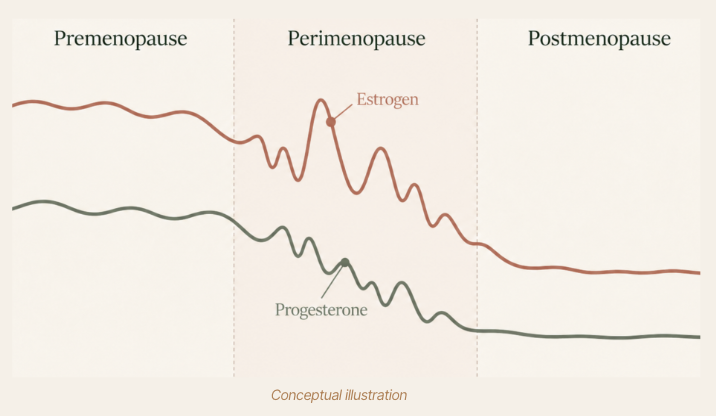
Perimenopause isn't a smooth hormonal decline. It's a period of increasing variability.
Do I need a hormone test?
Often, no. Hormone levels can fluctuate considerably from day to day and cycle to cycle. For women over 45 with typical symptoms and menstrual changes, clinicians generally identify perimenopause from the overall picture rather than relying on a single estradiol or FSH measurement.5
So rather than asking only, “What is my estrogen level?”, it can be more useful to ask: “What has changed, and does the overall pattern fit perimenopause?”
So what can perimenopause actually feel like?
There is no single perimenopause experience. Some women have relatively few symptoms. Others notice changes across several areas of their health at once.
Six domains of perimenopause
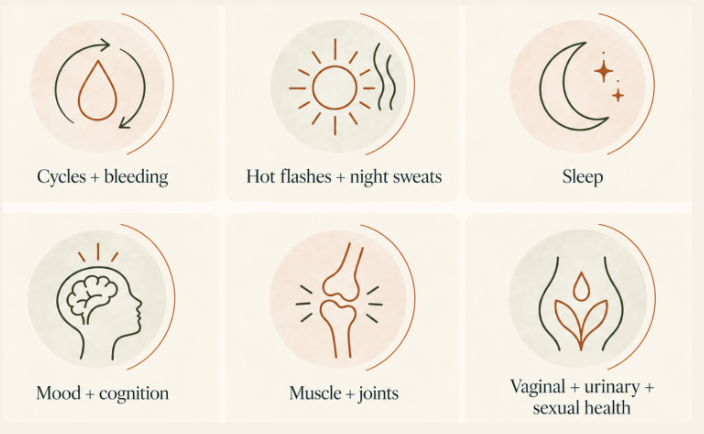
The pattern is different for every woman.
Cycles + bleeding
For many women, a changing menstrual cycle is one of the first obvious signs that something is shifting. Periods might become shorter, longer or less predictable. Flow may become heavier or lighter. You might skip a month. A pattern you've had for decades can suddenly stop feeling predictable.
Period changes are common during perimenopause, but bleeding between periods, bleeding after sex, unusually heavy or prolonged bleeding, or any bleeding after 12 months without a period should still be discussed with a clinician.6
Hot flashes + night sweats
Hot flashes and night sweats, known medically as vasomotor symptoms, may be the most recognizable symptoms of menopause. But even here, our expectations are often wrong.
In a landmark SWAN study of women who experienced frequent vasomotor symptoms, the median total duration was 7.4 years. Women whose symptoms began earlier in the menopause transition tended to experience them for longer.2
That doesn't mean every woman will have hot flashes or that yours will last for years. It does mean they aren't necessarily a brief inconvenience you simply need to tolerate.
Sleep
Sometimes perimenopause looks less like a dramatic hot flash and more like being wide awake at 3 a.m. You may struggle to fall asleep, wake repeatedly or find yourself awake far earlier than you want to be.
Night sweats can contribute, but they aren't the only reason sleep can become more difficult. Poor sleep also rarely stays contained to nighttime. It affects energy, recovery, concentration, mood and your capacity to handle everything else life is asking of you.
Mood + cognition
Some women notice changes in how they feel or think before menopause ever crosses their minds. You might feel more anxious, irritable or overwhelmed than usual. Your emotional buffer may feel thinner.
Cognition can feel different too. You walk into a room and forget why you're there. You lose a familiar word mid-sentence. Concentrating feels harder. You simply don't feel as mentally sharp as usual.
These experiences deserve attention without assuming that every mood or memory change is hormonal. Perimenopause also happens during a stage of life that can include demanding careers, children, aging parents, relationship changes, stress and disrupted sleep. Often there isn't a single explanation.
Muscle + joints
Your body may start giving you feedback it didn't used to give you. Your knees feel different going downstairs. Your shoulders are stiffer in the morning. Recovery takes longer. Maintaining the same strength feels harder even though you haven't intentionally changed your routine.
Not every new ache is caused by menopause. But muscle, strength and power become increasingly important in midlife for metabolic health, mobility and independence later in life.
Vaginal + urinary + sexual health
Vaginal dryness, irritation, discomfort with sex, urinary symptoms and changes in sexual health can also emerge during the menopause transition.
Many of these changes fall under the medical term genitourinary syndrome of menopause, or GSM. Women often talk about these symptoms far less than they talk about hot flashes or sleep, but they are worth bringing up.
Unlike hot flashes, which often improve over time, GSM can persist or worsen without treatment.7 Effective treatments are available. These are not simply changes women have to accept as an unavoidable part of getting older.
And sometimes it simply feels like: “My body is changing.”
This is one of the most common and frustrating experiences of midlife. But it's worth separating weight from body composition.
In a longitudinal SWAN analysis using DXA scans, researchers found that around the menopause transition, the rate of fat gain increased while lean mass began to decline. Interestingly, overall weight did not show the same menopause-specific acceleration.3
That distinction matters. “Menopause makes you gain weight” is too simplistic. The scale may not tell the whole story.
Changes in the balance of fat and lean tissue can occur during the transition, giving us another reason to prioritize strength training, adequate protein, movement and appropriate fueling in midlife.
The goal isn't simply to weigh less. It's to protect the tissue and capacity that help you stay strong.
Symptoms are the doorway. Long-term health is the bigger picture.
Perimenopause is not simply a collection of uncomfortable symptoms to manage until they disappear. It is also an important health transition.
Bone loss accelerates around the final menstrual period, making midlife an important time to pay attention to strength training, weight-bearing activity, adequate nutrition and individualized medical care when needed.8 Cardiovascular risk factors also evolve through midlife, and changes in lipids, body composition and vascular health can occur across the menopause transition.4
That isn't a reason to be frightened of menopause. It's a reason to pay attention.
Symptoms get our attention. Long-term health is why the foundations matter.
Those foundations are not particularly glamorous: strength, aerobic fitness, nutrition, sleep, recovery and appropriate medical care. But over time, they matter.
The bigger takeaway
Perimenopause can feel confusing precisely because it doesn't always look the way we expected it to. It may be hot flashes, but it may also be waking at 3 a.m., a period that suddenly arrives a week early, more anxiety, brain fog, aching joints or vaginal dryness.
Sometimes it is simply the sense that the body you've lived in for decades is responding differently than it used to.
Not every new symptom in your 40s is perimenopause. New, severe, persistent or concerning symptoms still deserve proper medical evaluation. But recognizing that you may be in a health transition gives you context, and context can help you ask better questions, make more informed decisions and focus your energy on the things that can genuinely support your health.
At Vitality, we believe midlife is a pivotal time for your health. The foundations you build now — strength, fitness, nutrition, sleep, recovery and the right medical care — can help shape how you feel and function not just today, but in your 50s, 60s, 70s and beyond.
This isn't simply a transition to get through. It's a chance to build the strength, health and resilience you want to carry with you for decades.