At first, I thought I was stressed. I was a COO with three young children, a demanding job, and a very full life. Of course I felt anxious and overwhelmed. There was an obvious explanation for it.
But something also felt different. I was having a harder time coping with the everyday ups and downs of life. Things I previously would have handled fairly easily suddenly felt much bigger. I could be completely fine one moment and disproportionately upset about something relatively minor the next. Intellectually, I knew my life was demanding, but my reactions did not always seem proportional to what was actually happening.
Then my periods became heavier. A little later, I was on vacation with my husband when I noticed that my hair was falling out. That was the point when I decided something was clearly going on, so I went to see my doctor.
She is an exceptional physician, someone I trust, and a woman herself. She listened, ran blood tests, and discovered that my iron was low. She recommended iron supplementation and discussed using an SSRI for the anxiety I was experiencing. That explanation made sense, but the symptoms kept accumulating.
My joints began to ache. My body seemed to be changing even though my habits had not meaningfully changed. I was becoming intensely irritable, sometimes feeling a level of anger toward my husband or children that simply did not feel like me. Because each symptom had a plausible explanation on its own, it was surprisingly easy not to see the pattern they were creating together.
The symptom that finally made me connect the dots
Then I started waking up sweaty in the days before my period. That caught my attention because I knew night sweats were associated with menopause. For the first time, I wondered whether hormones might be playing a role in what I was experiencing.
I went back to my doctor and asked whether I could be going through menopause. She felt I was too young, so I moved on. What neither of us focused on at the time was perimenopause, and my symptoms did not move on.
Eventually, I started researching on my own. That was when I learned much more about perimenopause, the years leading up to menopause when ovulation and hormone patterns can become increasingly variable. Suddenly, experiences that had seemed unrelated began to fit together: the changes in my periods, the anxiety, the sweating, the joint aches, the changes in my body, the irritability, and the sense that I simply was not quite myself.
I had known what menopause was. I had not understood what perimenopause could actually feel like.
What it felt like
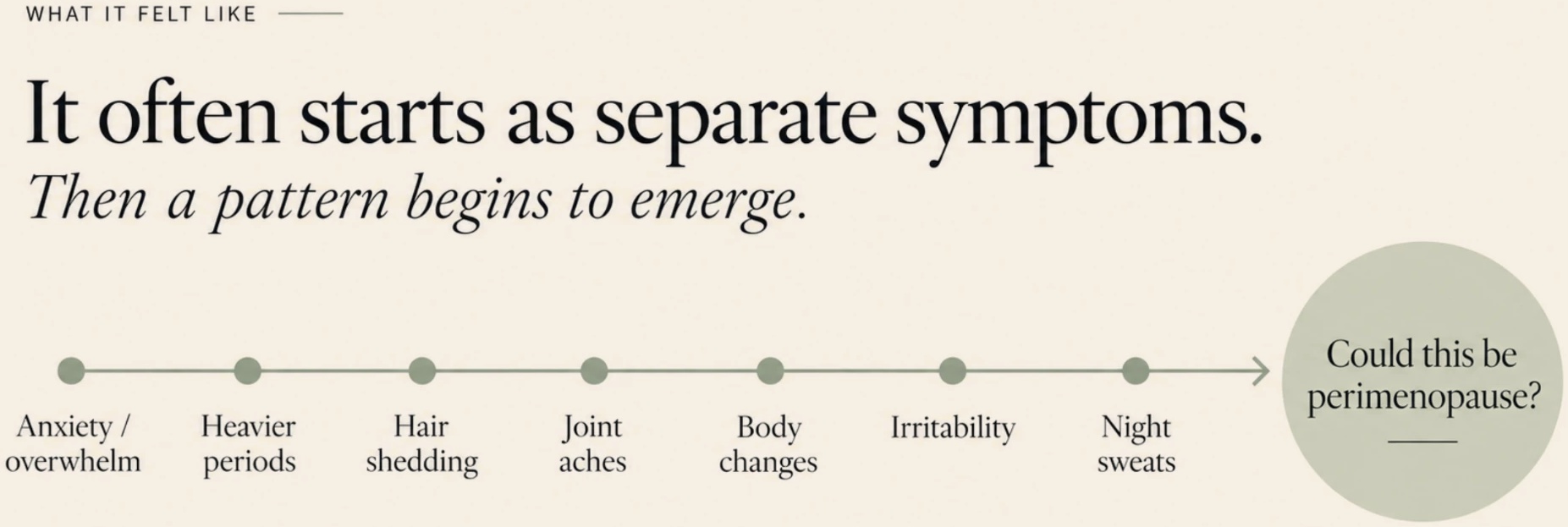
It often starts as separate symptoms.
Then a pattern begins to emerge.
- Anxiety / overwhelm
- Heavier periods
- Hair shedding
- Joint aches
- Body changes
- Irritability
- Night sweats
What I wish I had known
Eventually, after exploring my options with a doctor specializing in women’s health, I started menopausal hormone therapy and noticed a meaningful improvement in how I felt. But the most important lesson for me was not that there was one treatment I should have started sooner. It was that I had spent close to two years experiencing symptoms without understanding what was happening in my body.
I wish I had known that perimenopause can begin years before the final menstrual period, that it can look very different from one woman to another, and that you can still be having regular or semi-regular periods and be in perimenopause. When something continued to feel wrong, I also wish I had felt more confident asking additional questions or seeking another perspective.
My experience was not extreme. Many women experience symptoms that are far more disruptive and spend much longer trying to understand what is happening. That stayed with me.
Perimenopause got my attention. Longevity changed my perspective.
The more I learned, the more interested I became not only in perimenopause and menopause, but in the much broader question of women’s health in midlife. What surprised me was how much bigger the conversation was than hormones. I stopped thinking of perimenopause simply as a phase to manage and began thinking about my 40s as an important window for the decades ahead.
Muscle mass and strength become increasingly important. Bone health deserves attention. Cardiometabolic health matters. Sleep can become less predictable. Nutrition needs evolve. And the habits we build during midlife can influence how strong, capable, and healthy we remain decades from now.
That shift in perspective changed the way I thought about my own health. I was no longer asking only, How do I feel better right now? I was also asking, What do I want my health to look like at 60? At 70? At 80? And what can I do now to help build that future?
The problem is not always a lack of information
At the same time, women are surrounded by more health information than ever: protein, creatine, Zone 2, hormones, supplements, strength training, sleep trackers, continuous glucose monitors, fasting, longevity protocols. There is no shortage of advice.
What I began to realize is that most of the women I knew did not have an information problem. They had a prioritization and implementation problem. They were smart, motivated, and often already doing a lot. The challenge was figuring out what actually mattered for their health, what was worth ignoring, what to focus on first, and how to turn all of that information into something they could realistically sustain within a life that was already full.
I realized that I had spent much of my career doing a version of this in a completely different context: taking complicated problems, identifying what mattered most, and turning that clarity into action people could actually sustain.
That realization brought together two parts of my life that had previously felt separate: my long-standing interest in health and fitness, and my career helping organizations and people turn complicated problems into clear priorities and practical action. I decided to formally study health and wellness coaching while continuing to deepen my education in women’s health, behavior change, and healthy aging. That became Vitality Women’s Health.
What I want Vitality to be
Vitality is built around a simple idea: women should be able to feel better today while building the foundations for better health tomorrow. That means paying attention to symptoms, but not stopping there. It means looking beyond symptoms to the foundations that matter for long-term health: strength, nutrition, sleep, bone and cardiovascular health, recovery, and the right medical support when it is needed.
It also means recognizing that knowing what to do and actually doing it are two very different things. Most women do not need another long list of things they “should” be doing. They need help deciding what matters most, building a plan around their actual lives, and adjusting that plan when work gets intense, a child gets sick, travel disrupts their routines, motivation disappears, or life simply gets complicated.
That is where coaching can help. My role is not to give women a perfect-health checklist. It is to help them make sense of the noise, decide what deserves their attention, and translate what they know into changes they can actually live with. I want women to leave coaching feeling less overwhelmed by their health, more confident in their decisions, and clear about what they are actually going to do next.
At Vitality, I think about the work in three steps: Clarify. Build. Sustain.
Clarify
Understand what is changing and what matters most.
Build
Create a realistic plan around your health, goals, and life.
Sustain
Make the changes last through accountability, problem-solving, and course correction.
Midlife can be a beginning
I used to think about menopause largely as something that happened later in life. I see midlife very differently now. For many women, it is a moment when our bodies start asking us to pay closer attention. That can be frustrating or unsettling, but it can also be an opportunity to understand our health more deeply, become stronger, ask better questions, and be much more intentional about the decades ahead.
That is ultimately why I started Vitality Women’s Health. I want women to understand what is changing, know what deserves their attention, and have the support to turn that knowledge into action. Our 40s and 50s are not simply a transition to get through. They are an important opportunity to build the strength, habits, and health that can carry us through our 60s, 70s, 80s, and beyond.
Healthier today. Stronger tomorrow.